
Bringing Free Essential Items to Norfolk: Our Community Care Vending Machine Project
Most of us don’t think twice about everyday essentials—things like a toothbrush, deodorant, a bandage, or period products. They’re small, routine items that quietly support our daily lives.
But for many individuals in our community, access to these basics isn’t guaranteed.
In Norfolk and surrounding areas, gaps in access to essential items are more common than we might realize. These gaps often go unseen, but they can have a real impact—especially for individuals already navigating challenges related to mental health, substance use, or financial instability.
At The Well, we’ve seen how something small can quickly become a barrier. That’s why we’re working on a simple, practical solution: bringing a free community care vending machine to Norfolk.
The Hidden Gap in Basic Needs
While these challenges may not always be visible, data shows that access to basic essentials is a widespread issue.
Across the United States, millions of individuals struggle to consistently afford everyday hygiene products. Research shows that nearly 1 in 3 adults have had to choose between purchasing basic hygiene items and paying for other essential expenses such as food or utilities.¹ These are not luxury items—they are fundamental to health, dignity, and daily functioning.
Access to period products is another significant barrier. Studies have found that nearly 1 in 4 individuals who menstruate have struggled to afford period supplies, with many reporting missed school or work as a result.²
These challenges are often even more pronounced in rural communities like those across Northeast Nebraska. While Nebraska’s overall poverty rate is around 10–11%, local data shows that some counties experience significantly higher rates, with poverty levels reaching up to 18% in certain areas.³ In addition, many rural counties report lower median incomes and fewer available resources, which can make accessing even basic necessities more difficult.⁴
Limited transportation, fewer retail options, and gaps in community resources all contribute to these barriers. For individuals navigating mental health challenges, substance use recovery, or financial instability, these gaps can have an even greater impact. When basic needs aren’t met, it becomes more difficult to focus on stability, recovery, and overall well-being.⁵
A Small Solution with Big Impact
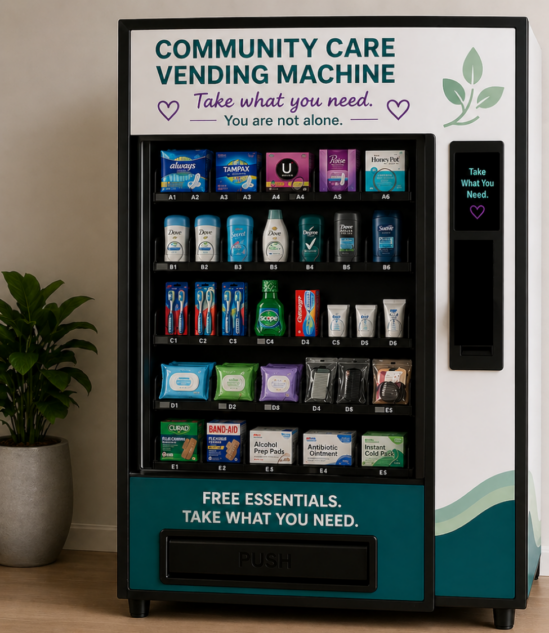
At The Well, we’re always looking for ways to respond to real needs in our community in practical, meaningful ways. That’s why we’re working to bring a community care vending machine to Norfolk.
This vending machine will be stocked with essential items, things like hygiene products, period supplies, and basic first aid items and made available at no cost to those in need.
More importantly, it will be designed to be low-barrier and stigma-free. Individuals won’t need to ask for help, explain their situation, or navigate complex systems to access basic necessities. Instead, they can simply take what they need, when they need it.
The machine will be located at our main CCBHC location in Norfolk, creating a central and accessible point for support. While it will be available to individuals currently receiving services at The Well, it is equally intended to serve the broader community, anyone who may need access to basic essentials.
Solutions like this have been implemented in communities across the country as a way to increase access to essential items while preserving dignity and privacy. Research continues to show that reducing barriers to care—especially small, everyday barriers—can have a meaningful impact on overall health and well-being.⁷
By creating a simple, accessible way to meet basic needs, this project aims to remove one more obstacle for individuals and families in our community.
Our Goal
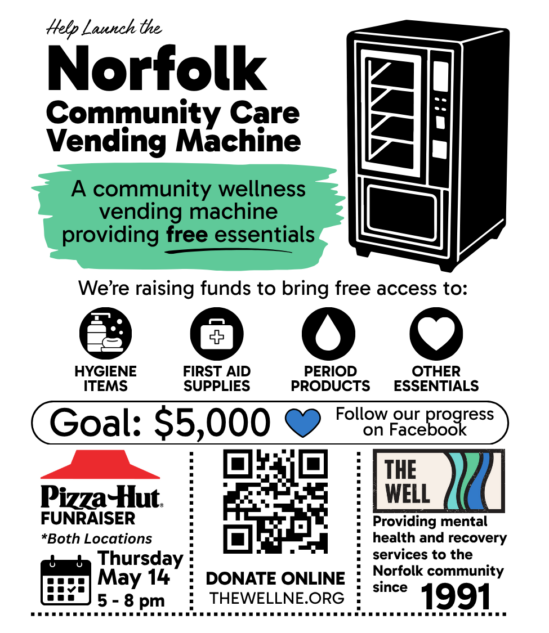
We are working to raise $5,000 to bring this project to life—covering the cost of the vending machine and providing an initial supply of essential items.
If we exceed this goal, additional funds will be used to keep the machine stocked over time, ensuring it remains a reliable resource for our community.
If we fall short of our goal, funds will still be used to support this effort by providing essential items directly to individuals currently receiving services at The Well.
How to Give
There are two simple ways to support this project and help bring a community care vending machine to Norfolk.
Join our Pizza Hut Fundraiser
We’re partnering with Pizza Hut for a one-night fundraiser! A portion of proceeds from orders during this time will go directly toward this project.
📅 Date: Thursday, May 14th
⏰ Time: 5:00 PM – 8:00 PM
📍 Location: Both Pizza Hut locations in Norfolk
Whether you dine in or carry out, your meal can help make a difference.
Donate Online
If you’re unable to attend, you can still support this effort by making a direct donation.
👉 TheWellNE.org
Supporting Our Role as a Certified Community Behavioral Health Clinic
As a Certified Community Behavioral Health Clinic (CCBHC), The Well is committed to providing comprehensive, accessible care that meets the full range of needs within our community—not just clinical services, but the factors that impact overall health and well-being.
CCBHCs are designed to address both behavioral health needs and the broader challenges individuals face, including barriers related to access, stability, and social determinants of health. This means looking beyond traditional services and identifying practical ways to support individuals in their day-to-day lives.
Projects like the community care vending machine are a direct extension of that work.
By increasing access to basic essentials in a low-barrier, stigma-free way, we are supporting the same goals that guide our CCBHC services: improving health outcomes, reducing barriers to care, and meeting people where they are.
If you’d like to learn more about what it means to be a CCBHC and how this model supports communities like Norfolk, you can read more here.
References
- National Diaper Bank Network – Hygiene Poverty
https://nationaldiaperbanknetwork.org/ - PERIOD. – Period Poverty and Stigma / State of the Period 2023
https://period.org/periodpoverty - U.S. Census Bureau QuickFacts – Norfolk city, Nebraska
https://www.census.gov/quickfacts/fact/table/norfolkcitynebraska/BZA115223 - Census Reporter – Norfolk, Nebraska Profile Data
https://censusreporter.org/profiles/16000US3134615-norfolk-ne/ - USDA Economic Research Service – Rural Poverty & Well-Being
https://www.ers.usda.gov/topics/rural-economy-population/rural-poverty-well-being - SAMHSA – Recovery and Recovery Support
https://www.samhsa.gov/substance-use/recovery - NIH / National Library of Medicine – Social Determinants of Health and Substance Use Disorder
https://pmc.ncbi.nlm.nih.gov/articles/PMC11418584/
Related Posts

Wellbriety: A Path to Healing Through Culture, Connection, and Community
At The Well, we believe that recovery is not one-size-fits-all. For many individuals, healing is most meaningful when it connects not only to the mind and body—but also to culture, […]
Read More

Board Opportunity: Help Shape the Future of Behavioral Health in Northeast Nebraska
The Well has been serving the Norfolk community since 1991, when it began as a small halfway house for women. Since then, we’ve grown alongside the needs of our community—expanding […]
Read More

2025 Client Holiday Donation Drive
Hope for the Holidays: Supporting Clients at The Well This Season Every day at The Well, we welcome individuals who are trying to create a better future. Some are beginning […]
Read More